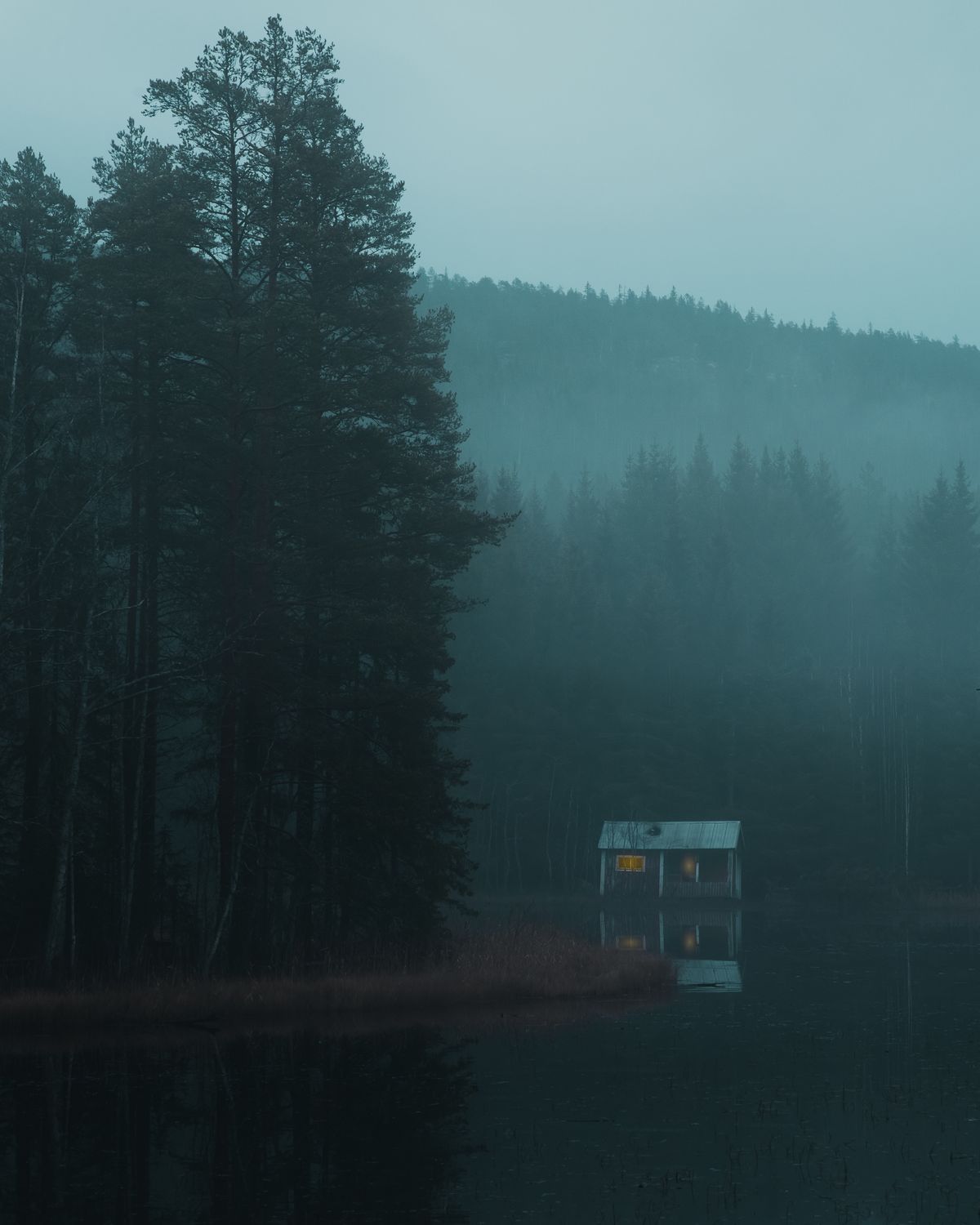
The first time it happened to me, I pulled over because I thought I was trespassing. I had been driving a back road through the forests of Dalarna, had spotted a lake through the trees — silver and still in the morning light — and had pulled the car onto the grass verge and walked toward it. No path. No sign. Just birch forest and then the sudden cold of the lake at my ankles.
A woman came past with a dog twenty minutes later, while I was sitting on a rock eating breakfast. I started to gather my things, ready to apologise. She looked at me with genuine puzzlement. "You don't have to go," she said. "It's everyone's land." Then she walked on.
It took me most of the trip to internalise what that meant. Everyone's land. Not public land in the sense of a designated park or nature reserve. Not a permissive path marked on an OS map. Any land. The private farmland stretching to the horizon. The forest behind the farmhouse. The shoreline of the lake you can see from the road. All of it, legally and by long tradition, open to you.
What Is Allemansrätten?
That is Allemansrätten. And there is nothing quite like it anywhere else in the world.
What Allemansrätten Actually Is
Allemansrätten — literally "every man's right" — is a constitutional principle in Swedish law that gives every person the right to access nature, regardless of who owns the land. It applies to Swedish citizens and foreign visitors equally. It has no expiry date, no permit requirement, no application process. You do not need to ask permission. You do not need to inform the landowner. You simply go.
What the Right Covers
The right covers a genuinely remarkable range of activities. You may walk, cycle, ride horses and ski across private land. You may camp overnight in tents — typically up to two nights in one spot without asking, longer with the landowner's consent. You may swim and paddle in any lake, river or stretch of coastline. You may pick wild berries, mushrooms and flowers. You may light a small fire where it is safe to do so. You may land a small boat on any shore.
The principle is codified in Sweden's Environmental Code, but it predates modern law by centuries. Historians trace it to medieval customs around forest use — the idea that the wilderness belonged, in a meaningful sense, to everyone who needed to move through it, not just to the noble families who technically owned the ground. When Sweden's constitution was modernised in the twentieth century, Allemansrätten was written into it as a fundamental right. It sits alongside freedom of speech and freedom of assembly in the hierarchy of things the Swedish state guarantees to its people.
This is not, in other words, a loophole or a technicality. It is a value. The Swedish relationship with nature — the conviction that access to forests and water is a basic human need, not a privilege to be bought or granted — runs so deep that it has been embedded in the legal architecture of the country at the highest possible level.
Why It Is Unique — Even in Scandinavia
Allemansrätten is often described as a Scandinavian phenomenon, and it is true that Norway and Finland have comparable traditions. Norway's friluftsloven (outdoor recreation act) and Finland's everyman's rights extend similar freedoms. But Sweden's version is both the most comprehensive and the most genuinely embedded in everyday cultural life.
In most of the world, private land is private. Full stop. In England, the Countryside and Rights of Way Act 2000 — celebrated at the time as a breakthrough — gives walkers access to designated open land: mountains, moors, heaths and downs. It excludes farmland entirely. It excludes most woodland. It covers roughly eight percent of England's land area. Scotland has stronger access rights, but Scotland is unusual, and the rights there were only enacted in law in 2003 after decades of campaigning.
In the United States, the concept barely registers. Land is privately owned and the owner's rights are close to absolute. In most of continental Europe — France, Germany, Spain, Italy — walking across private farmland or camping in a private forest without permission is technically illegal, whatever local custom might say about it.
Sweden's Allemansrätten covers virtually all land. Forests, farmland (outside the growing season), lakeshores, river banks, islands, mountain slopes. If you can see it, you can almost certainly go there. The exceptions are narrow and logical: you cannot cross a private garden, you cannot walk through cultivated crops, you must stay away from the immediate vicinity of farm buildings. Beyond those constraints, the country is open.
The difference in practice is not incremental. It is categorical. In England you navigate between footpaths, reading signs, watching for "Private" notices, calculating whether the farmer will mind. In Sweden you simply walk in any direction until you find what you are looking for.
🌍 Allemansrätten vs Right to Roam: A Quick Comparison
Sweden: All land, all seasons, camping up to 2 nights anywhere, foraging unlimited, swimming anywhere. Constitutional right.
Scotland: Most land, year-round, camping permitted, foraging for personal use. Enacted 2003.
Norway: Uncultivated land, camping 150m from houses permitted, foraging permitted.
England/Wales: Designated open land only (~8% of total land area), no camping right, no foraging right.
Germany/France/Spain: No general access right to private land. Marked trails only.
What You Can and Cannot Do
The principle behind Allemansrätten is summarised in Swedish as "inte störa, inte förstöra" — do not disturb, do not destroy. The right comes with responsibilities, and those responsibilities are taken seriously. Swedish schoolchildren learn Allemansrätten as part of the national curriculum. It is covered in driving tests. It is referenced in hiking guides, rental agreements and outdoor education programmes. The Swedes understand it as a mutual compact: the land is open because people will treat it well.
✓ You May
- Walk, cycle or ski across private land
- Camp overnight (up to 2 nights in one place)
- Swim in any lake, river or sea
- Pick wild berries, mushrooms and flowers
- Light a small campfire (where safe)
- Land a boat on any shore
- Let children play in forests and fields
- Walk dogs (on a lead near livestock)
- Ski across frozen lakes and fields
✕ You May Not
- Enter private gardens or farmyards
- Walk through standing crops or planted fields
- Drive off-road on private land
- Camp immediately beside a private home
- Light fires in dry conditions or on bare rock
- Take protected plant species
- Disturb nesting birds or their eggs
- Leave litter of any kind
- Stay more than 2 nights without asking
The fire rule deserves a specific note. Sweden is a heavily forested country, and fire risk in summer can be serious. During periods of high fire risk — which Swedish authorities announce publicly — open fires are prohibited even under Allemansrätten. Always check the fire risk level before lighting anything, and use established fire rings where they exist. A gas stove is the sensible alternative in summer.
The two-night rule is also frequently misunderstood. Two nights in the same spot without asking is a guideline, not a hard legal limit — Swedish law does not actually specify a number of nights, and the principle is really about not establishing a semi-permanent camp that inconveniences the landowner. If you are clearly moving through a landscape rather than setting up residence in someone's field, you are almost certainly within the spirit of the right.
The Practical Reality: What It Means on the Ground
I have camped under Allemansrätten many times now, in different parts of Sweden, and the practical experience of it is genuinely unlike camping anywhere else I have been. In most countries, wild camping carries a low-grade anxiety: the awareness that you are probably breaking a rule, the slight tension when you hear footsteps, the calculations about whether to hide the tent or brazen it out. None of that exists here.
On the shore of Lake Siljan in Dalarna, I pitched my tent on a flat piece of grass twenty metres from the water's edge. There was a farmhouse visible through the trees, maybe two hundred metres away. No one came. No one looked askance. The following morning a man walked past with two children and a dog; the children stopped to look at the tent with curiosity; the man nodded. That was the entirety of the interaction.
On the High Coast in Ångermanland, I found a shelf of rock above the sea, sheltered from the wind, with a view across the Baltic that made the term "Baltic" seem absurd — it looked like an ocean, enormous and cold and entirely unoccupied. I spent two nights there. No boat came. No one appeared on the shore below. The only sound was wind in the pines and the creak of the rock cooling after the day's sun.
Near Abisko in Lapland, in late August, I woke to find two reindeer standing fifteen metres from my tent. They regarded me without apparent concern for approximately three minutes and then walked away. This is not a Coldcation anecdote invented for effect. It happened because I had camped in a mountain valley under Allemansrätten, and the reindeer, who belong to the Sami herder whose land it technically was, had wandered over to investigate.
Allemansrätten and Foraging
The foraging rights under Allemansrätten are their own category of extraordinary. In Sweden, you may pick any wild berry, mushroom or flower on any land, in any quantity, for personal use. There is no permit, no seasonal licence, no limit on how much you take for yourself. You can fill a bucket with chanterelles from a private forest and leave with them without a word to anyone.
This is not hypothetical. Swedes forage seriously. The arrival of chanterelle season in July and August triggers a genuine national migration toward forests. Families have their own spots — often secret ones, passed down between generations — where they know the mushrooms come up reliably. The same is true for cloudberries in the northern bogs, lingonberries on the heathland, blueberries in the birch forest understorey.
The mushroom season in September, when porcini and hedgehog mushrooms join the chanterelles and the forests smell of damp earth and something darker, is probably the richest expression of Allemansrätten in practice. Walk into any Swedish forest in September with a basket and you will come out with something. The question is only what and how much.
Commercial foraging — picking in large quantities to sell — occupies a legal grey area under Allemansrätten, and some landowners have opinions about it, particularly in areas where professional foragers have become a visible presence. For recreational foraging, the right is unambiguous and absolute.

Swimming and Water Access
Sweden has 97,500 lakes. Under Allemansrätten, you may swim in every single one of them. You may also swim in every river, every stretch of coastline, every canal. The water access rights are among the most compelling aspects of the principle for visitors — in most of Europe, lakefront access is controlled by the property surrounding it, which often means private jetties, locked gates and waterfront that is accessible only to those who can afford it.
In Sweden, the shore belongs to everyone. Waterfront property can include the land right down to the water's edge, but the water itself and a narrow strip of shore for movement and swimming is always accessible. You can kayak along a coast lined entirely with private cabins and still stop at any beach, swim, eat lunch on the rocks and move on. The cabin owners knew this when they bought. It is simply how it works.
This has a significant practical effect on the quality of a Swedish holiday. The lakes in Dalarna, the archipelago islands outside Stockholm, the rivers of Lapland, the long sand beaches of the Baltic islands — all of it swimmable, all of it reachable, none of it behind a paywall or a permission requirement. The swimming in Sweden is, as a direct result, among the best in Europe. Not because the water is the warmest — it is not — but because the access is total.
🏊 Best Swimming Under Allemansrätten
Lake Siljan, Dalarna: Crystal-clear glacial lake. Enter from any point of the shore. The lake is cold even in August; that is the point.
Stockholm Archipelago: Kayak to any of 27,000 islands, land wherever you like, swim off the rocks. No booking required.
Höga Kusten (High Coast): Dramatic rock shelves above the Baltic. The water is colder than the Adriatic and considerably cleaner.
Lapland rivers: The Torne, Kalix and Lule rivers run through untouched wilderness. Swimming in glacial river water at midnight in July, under a sun that has not set, is an experience that resists adequate description.
Why Allemansrätten Is the Coldcation Principle
There is a particular type of holiday that Allemansrätten makes possible, and it is not one that can be easily replicated elsewhere. It starts from the observation that most outdoor holidays involve a great deal of logistics that have nothing to do with nature: finding permitted campsites, booking in advance, paying fees, moving on when your two-night maximum expires, avoiding the privately owned lakeshore that looks better than the designated swimming beach.
Allemansrätten eliminates most of that. A Coldcation in Sweden, properly understood, works like this: you arrive, you drive or cycle or walk in whatever direction seems interesting, and when you find the right lake or forest or coastline — the one that has the quality of light you wanted, the silence you came for, the particular combination of trees and water that makes you feel, finally, that you are somewhere — you stop. You put up your tent. You swim. You pick berries for breakfast. You stay as long as you need. Then you move on.
This is not a description of wild camping as it is practised anxiously in countries where it is technically illegal. It is a description of ordinary use of the Swedish countryside, as Swedes have used it for centuries, extended without restriction to every visitor who comes.
The economic implications are worth noting too. A Coldcation built around Allemansrätten costs almost nothing for outdoor accommodation. Sweden has 700,000 second homes — one for every fourteen residents — but the visitors who come without a cabin connection can simply camp freely. The money saved on accommodation can go toward the things Sweden does charge for: the restaurants, the craft breweries, the guided wildlife experiences, the archipelago ferry crossings. A week in the Swedish wilderness, camping freely under Allemansrätten, can be one of the cheapest serious holidays in Europe.

The Deeper Thing Allemansrätten Does
There is something that happens when you spend time in a landscape that is genuinely open to you — not as a permitted visitor, not as a paying customer, not as someone who has followed the correct path and stayed inside the designated area. Something shifts in how you perceive the relationship between yourself and the place you are in.
Most outdoor access in most countries is structured around the idea that you are a guest in someone else's landscape, and your enjoyment of it depends on their tolerance. You stay on the path. You do not pick the flowers. You do not light a fire. You do not sit in that meadow, because that meadow, however beautiful, is not yours to sit in.
Allemansrätten says something different. It says: this landscape is yours too. You have a stake in it, a responsibility toward it, and a right to be in it that no individual's property ownership can extinguish. The reciprocal obligation — to leave it as you found it, to not disturb the people who live there, to treat the land as the shared inheritance it is — is the price of the right. Most visitors find they are willing to pay it with enthusiasm. The land, when it genuinely belongs to you, turns out to be much easier to care for.
That might be the most unexpected thing Allemansrätten teaches. Not just how to use a landscape, but why it matters that the landscape is, in the deepest sense, everyone's.
Practical Tips for Visiting Under Allemansrätten
Pack a lightweight tent that can be pitched on rocky ground — many of the best spots in Sweden, particularly on the High Coast and in the archipelago, are on granite rather than grass. A footprint or groundsheet is useful. Stakes that work in both soil and rock (guylines attached to boulders) give you flexibility.
Carry a water filter. Sweden's lakes and rivers are among the cleanest in Europe and many are safe to drink from directly, but a filter removes all doubt and weighs almost nothing. The Sawyer Squeeze and Lifestraw systems are reliable and light.
Learn to recognise the key edible species before you go if you intend to forage seriously. Chanterelles are distinctive enough that misidentification is unlikely, but porcini has looser lookalikes and it is worth spending an hour with a good field guide before you arrive. The Swedish app Naturkartan has a foraging guide with local conditions and species reports.
Respect the fire rules — this cannot be overstated. The Swedish Fire Risk level (Brandrisk) is published daily at smhi.se. A gas stove and a vacuum flask of hot water will serve you better on most summer evenings than a fire that is technically legal but environmentally marginal. Save fires for autumn and shoulder season, when the ground is damper and the risk lower.
And finally: go slowly. Allemansrätten is not a sightseeing permit. It is an invitation to be somewhere properly, rather than passing through. The lake you find on your second morning, the one not on any map, the one where the water is so cold it makes your breathing stop — that is the one worth staying at.
What You Can and Cannot Do: Quick Reference
| Activity | Allowed? | Conditions |
|---|---|---|
| Camping in forest/field | ✅ Yes | 1–2 nights, not in sight of dwelling, leave no trace |
| Swimming in any lake/river | ✅ Yes | Any water body, any time |
| Picking berries and mushrooms | ✅ Yes | Any land, personal use |
| Lighting a campfire | ✅ Usually | Not during fire bans; on bare ground only |
| Cycling/walking on private land | ✅ Yes | Not damaging crops or fences |
| Entering private gardens | ❌ No | Tomt (curtilage around dwelling) is excluded |
| Walking through cultivated fields | ❌ No | Growing crops are protected |
| Driving off-road vehicles | ❌ No | Motorised vehicles need landowner permission |
| Commercial tours on private land | ⚠️ Requires permission | Personal use only; commercial use needs agreement |
Mistakes Tourists Make with Allemansrätten
❌ Camping within sight of a dwelling
The Distance Rule
The most common misunderstanding. "Not within sight of a dwelling" means exactly that — if the people in the house can see your tent from their windows, you are too close. In practice this means at least 150–200 metres from any house, usually more in open terrain. Screening by trees or terrain counts: you can camp closer if you genuinely cannot be seen. When in doubt, move further away.
❌ Lighting fires during a fire ban
Allemansrätten does not override fire bans (eldningsförbud). During dry conditions, Swedish authorities issue bans on all open fires across wide areas — these are legally binding and carry fines for violation. The Swedish Meteorological Institute (SMHI) publishes fire risk assessments and bans at smhi.se. Check before lighting anything, particularly in summer. A fire in the wrong conditions in a Swedish forest can spread extremely fast.
❌ Treating it as a complete free pass
Allemansrätten is a right balanced by responsibility. The principle Swedes use: leave no trace, disturb nothing, don't cause inconvenience to the landowner. In practice this means: don't leave rubbish, don't pick flowers from someone's garden (even if it's an untended field), take down your tent and clear your fire ring before leaving, and behave as a guest in someone else's landscape — because legally, that's exactly what you are.
Frequently Asked Questions: Allemansrätten
Can I really camp anywhere in Sweden?
Yes — Allemansrätten gives you the right to camp on any land in Sweden for one or two nights without asking permission. The limits: don't camp within sight of a dwelling, don't damage the land or vegetation, leave no trace, and don't outstay two nights in one spot. This applies to private farmland, forests, coastline, and lakeshore equally. It is enshrined in Swedish law and in the national constitution.
Does Allemansrätten apply to foreigners?
Yes, completely. Allemansrätten applies to everyone physically present in Sweden, regardless of nationality. There are no permits, registrations or fees. The right is unconditional, subject only to the behavioural responsibilities that accompany it (leave no trace, respect the landowner's actual use of the land, don't damage crops or fences).
Can I light a fire under Allemansrätten?
Open fires are permitted under Allemansrätten in most conditions, but with significant caveats. During dry weather or when fire warnings are in place (brandförbudet), all open fires are prohibited by law regardless of Allemansrätten. Even without a fire warning, use caution: make fires on bare ground or rock, never on peat or dry vegetation, extinguish completely. The Swedish Meteorological Institute (SMHI) publishes daily fire risk forecasts. Check before lighting.
Can I pick berries and mushrooms in Sweden?
Yes — foraging for wild berries and mushrooms is explicitly covered by Allemansrätten. You can pick berries, mushrooms and other plants from any land in Sweden, in any quantity for personal use. Commercial harvesting operates under different rules. The forests of central and northern Sweden yield chanterelles, porcini, lingonberries, blueberries and cloudberries in season — late July through October depending on species and latitude. If you are planning a spring visit, our Sweden Spring guide covers the best timing, what to expect and what opens in April and May.
What are the limits of Allemansrätten?
You cannot enter cultivated land (fields of crops), gardens, or areas immediately surrounding dwellings. You cannot drive off-road vehicles on private land. You cannot cut trees or damage vegetation deliberately. You cannot disturb wildlife during nesting season. Commercial use of Allemansrätten access rights (e.g. running a paid foraging tour on private land) requires landowner permission. The principle is simple: enjoy freedom, exercise responsibility.
→ Also see our fishing in Sweden guide — salmon, pike, sea trout and ice fishing across the country.