In August 2025, France recorded its largest wildfire in modern history. A blaze in the Aude department in the southwest burned through approximately 170 square kilometres of land before it was brought under control. Around the same time, southern Spain recorded a single-day temperature of 45.8°C in Jerez de la Frontera. Greece was battling fires on multiple fronts simultaneously — Attica, Crete, Evia and Kythera — forcing the evacuation of more than 32,000 people, including 5,000 tourists on Crete alone.[1,2,3]
This was not a one-off summer. Summer 2025 was Spain's hottest on record since measurements began in 1961, with a national average of 24.2°C across the season — 2.1 degrees above the 1991–2020 baseline. A record 382,000 hectares burned in Spanish wildfires, surpassing the previous record set in 2022.[4] According to ECMWF, summer 2025 was Europe's worst year for wildfires in terms of area burned in two decades.[5]
And while all of this was happening, we were in Sweden. The temperature when we arrived in Stockholm was 21°C. There was a wind off the water. We sat outside for every meal that week.
The Numbers Behind the Shift
How fast is the Mediterranean warming?
The short answer: faster than almost anywhere else on Earth. The Mediterranean region is warming approximately 20% faster than the global average, according to the United Nations. Europe as a whole has been warming twice as fast as the global average since the 1980s, according to the EU's Copernicus Climate Change Service.[4,6] The 2025 European State of the Climate report, published by Copernicus, confirmed that above-average temperatures were recorded across at least 95% of Europe and that the continent remains the fastest-warming landmass on Earth.[7]
This is not a prediction about the future. It is a description of conditions that existed last summer, and the summer before that, and — with growing frequency and intensity — the summer before that.
What this looks like for tourists
The fires and the heat are not a background story that tourists can ignore. They are the holiday itself. In the summer of 2023, more than 19,000 people were evacuated from Rhodes as wildfires burned across the island — tourists were bussed from hotels to stadiums, flights were cancelled, travel agents chartered additional aircraft to bring people home.[8] Greece subsequently offered free return visits to all tourists who had been forced to leave — an acknowledgment that the holiday they had bought had not been delivered.[9]
In 2025, the pattern repeated at larger scale. The World Weather Attribution group found that climate change had made the conditions leading to the Turkish, Cypriot and Greek wildfires of 2025 up to ten times more likely than they would have been in a pre-industrial climate.[3] The fires did not respect hotel brochures or flight bookings.
August 11, 2025: Temperatures soared past 43°C in southern France and the Western Balkans. Bulgaria reported nearly 200 simultaneous wildfire outbreaks. Italy closed Mount Vesuvius to tourists after fire swept across its slopes. Authorities in Hungary recorded the hottest weekend in that country's recorded history. All of this happened in a single week.[1]
Why This Is Not Going to Get Better
Scientific analysis published in Scientific Reports examined national wildfire statistics across southern Europe between 1981 and 2025. Its finding was direct: in vast parts of the Iberian Peninsula, France, Italy and Greece, summer days featuring extreme fire-prone conditions have more than doubled over that period. The paper described southern Europe as entering "an era of extreme fire risk" and noted that recent fire seasons have increasingly exceeded existing suppression capacity.[10] The summer of 2026, underway as this article is updated, has already confirmed that trajectory. A separate World Weather Attribution analysis of the 2026 France and Spain fires found that climate change significantly increased the likelihood of the conditions that drove them.[A5]
The Mediterranean is warming approximately 1.5–2°C above pre-industrial levels already. Projections suggest it could reach 2.2–5.6°C above baseline by 2100.[11] The UN's assessment that the Mediterranean is heating 20% faster than the global average is not a worst-case scenario. It is the current rate of change.
Once temperatures pass 32°C, research shows that tourist satisfaction drops sharply. Southern Europe is hitting that threshold nearly three weeks earlier in the season than it did in the 1980s.[12]
What Sweden Was Like That Same Week
The temperature
Stockholm in July averages 22°C. During the week we were there — the same week that France was recording 43°C and Vesuvius was on fire — the temperature in Stockholm reached a maximum of 25°C on one afternoon and sat between 19 and 23°C for the rest. We walked continuously from morning to late evening. We ate every meal outside. We swam in the archipelago at 7pm in 18°C Baltic water that was cold enough to be genuinely refreshing rather than the bath-temperature Mediterranean alternative.
There were no air conditioning requirements. There were no afternoon retreats to avoid the heat. The sun was still up at 10pm and the sky didn't go properly dark until almost midnight. We had more usable hours in each day than in any Mediterranean holiday we could remember.
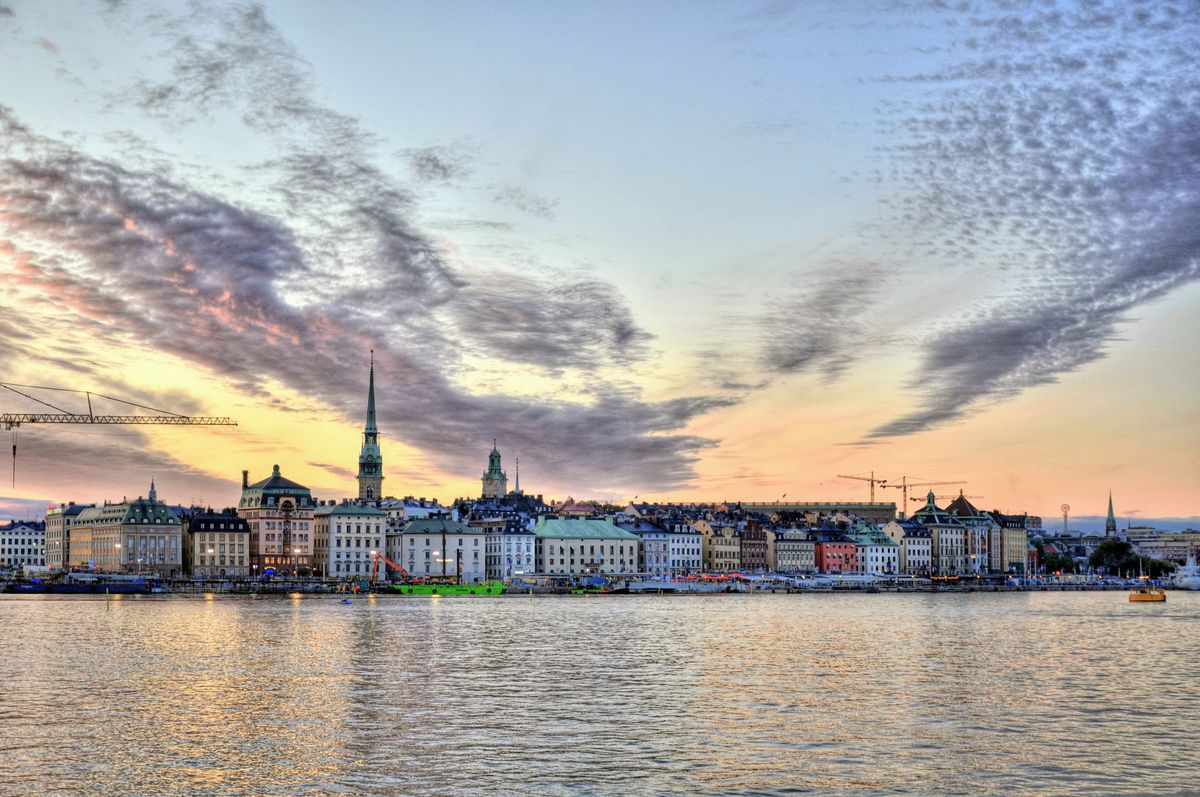
The archipelago
We took the Waxholmsbolaget public ferry from Strömkajen — 40 minutes to Vaxholm, a further hour to the outer islands. The water in the archipelago is clean enough to swim in directly off the granite rocks. There are no beach clubs, no sun-bed reservations, no entry fees. Under Allemansrätten — Sweden's constitutional right to roam — you may walk, camp and swim on any land in the country. The shoreline we swam from belonged, technically, to someone. We had the legal right to be on it regardless.
No wildfire risk. No air quality alerts. No smoke on the horizon turning the sky orange. Just cold water, warm granite and 18 hours of light.
The trend is already visible in the data
We were not alone in making this calculation. The European Travel Commission's 2025 data found that 81% of European travellers say climate change now affects how they plan holidays, with 15% actively seeking milder climates and 14% avoiding destinations prone to extreme heat.[13] Northern European destinations recorded significant increases in inbound tourism: Finland up 14.1%, Norway up 12.9%, Iceland up 10%. Lithuania recorded a 22.8% increase in international overnight stays.[13]
Sweden's position within this shift is clear. The country sits between 56° and 69° North. Its summers are mild, its water is clean and its entire territory is legally open to visitors under Allemansrätten. It is, in both climate and access terms, the structural opposite of what is happening in the south.
The Honest Comparison
| Southern Europe (Summer 2025) | Sweden (Same Period) | |
|---|---|---|
| Temperature | 2025: 45.8°C (Spain). 2026: 48.4°C (Sicily) — hottest recorded in Europe; June 2026 was 3.06°C above recent average — Western Europe's hottest June ever | 19–25°C; comfortable all day, every day |
| Wildfire risk | 2025: fires in France, Spain, Greece, Turkey. 2026: 400,000 evacuated, fires in 6 countries simultaneously, 14 dead in single Spanish fire | No meaningful wildfire risk in summer |
| Air quality | Smoke warnings across multiple countries | Clean air; 98% renewable electricity grid |
| Evacuation risk | 2025: 32,000+ in Greece. 2026: 400,000 across France and Spain — France's biggest peacetime evacuation since WWII | Zero evacuation orders for tourists |
| Swimming | Beach clubs; sun-bed fees; warm, crowded water | Free; clean; archipelago and lakes; cold and refreshing |
| Daylight | 15h, but 5h unusable due to peak heat | 17–18h; all usable |
| Trend direction | Getting hotter, drier, more fire-prone every year | Stable; within normal seasonal range |
This Is Not an Anti-Mediterranean Argument
The Mediterranean is one of the world's great travel regions. The food, the history, the architecture, the light in September and October when the temperatures become manageable again — none of that disappears. The argument here is narrower: the specific product of the Mediterranean summer holiday, sold on the premise of warm weather and sunshine and beach days, is delivering increasingly problematic conditions in July and August. The product has not changed. The climate delivering it has.
If you want Greece, go in May or October. If you want Spain, April or November. The shoulder seasons in southern Europe are often genuinely better than the peak anyway — lighter crowds, lower prices, tolerable temperatures, most of the sights still open. The Mediterranean summer as a concept has not failed. The Mediterranean July has.
Where Sweden Fits Into This
Sweden is not for everyone at every budget, and we have never pretended otherwise. Stockholm hotel prices in July are comparable to London. The country is large and the distances between its most spectacular landscapes are real. If what you want is guaranteed 35°C sun on a beach with cheap wine and no complications, Sweden will not deliver that and we should be honest about it.
What Sweden does deliver — consistently, reliably, in ways that have become more rather than less compelling as the south has heated — is summer at a human scale. Twenty-two degrees. Clean water. The legal right to be anywhere in the country. An archipelago that begins where the city ends. Light that lasts until midnight. A culture that knows precisely what summer is worth because it has spent eight months without it.
In the week that Vesuvius was on fire and southern France was recording temperatures no human body is designed to function in, we were sitting on a granite rock in the Stockholm archipelago watching the sun go down very slowly over pine-covered islands. The water was 18°C. The nearest wildfire was approximately 3,000 kilometres away.
This is what we built Coldcation to help people find. The guides are at the links below.