The phrase first appeared on Coldcation.se and in a handful of travel newsletters in 2025. By summer, it was being used in CNBC travel segments and EU climate tourism reports. The concept is simple enough to fit on a map: the 45th parallel north runs through the middle of France, northern Italy, the northern Balkans and the American Midwest. Everything below it in Europe — Spain, Portugal, Greece, southern Italy, the Mediterranean coast of France — has a summer problem. Everything above it, by comparison, does not.
Escape45 is the deliberate act of crossing that line. It's not a new idea; it's the first time the idea has had a name.
What the 45th Parallel Actually Means
The 45th parallel north — latitude 45°N — runs through Bordeaux, Turin, Belgrade, Bucharest and Vladivostok. It is exactly halfway between the equator and the North Pole. Below it in European summer, solar angles are steep enough, days long enough, and the land mass heat-retentive enough that temperatures in major cities regularly exceed 35°C. Urban heat islands add 5–8°C on top. Athens in July 2024 averaged 39°C for two consecutive weeks. Rome recorded 42°C. Madrid hit 44°C — the hottest July day ever recorded in the city.
Above the 45th parallel, things are different. The same amount of solar energy arrives at a lower angle, spreading over a larger surface area. The days are longer — giving the sun more time, but also spreading the heat — but the thermal mass of the landscape, the proximity of the Atlantic and the Baltic, and the sheer latitude combine to moderate what accumulates. Stockholm, at 59°N, averaged 23°C in July 2024. On the hottest day that summer — a day when Athens was at 40°C — Stockholm reached 28°C and returned to 20°C the following morning.
📍 Where the 45th parallel runs through Europe
| City | Latitude | July avg high | vs Stockholm |
|---|---|---|---|
| Athens | 37°N | 33°C | +10°C hotter |
| Rome | 41°N | 31°C | +8°C hotter |
| Madrid | 40°N | 32°C | +9°C hotter |
| Barcelona | 41°N | 28°C | +5°C hotter |
| Lyon | 45°N — the line | 28°C | +5°C hotter |
| Edinburgh | 55°N | 19°C | –4°C cooler |
| Copenhagen | 55°N | 22°C | –1°C cooler |
| Stockholm | 59°N | 23°C | baseline |
| Kiruna | 67°N | 18°C | –5°C cooler |
July average highs, 2020–2024. Source: climate data from national meteorological services.
The Gap Is Getting Wider
The 45th parallel has always been a meaningful climatic boundary. What has changed is the magnitude of the difference and the consistency with which southern Europe now exceeds survivable comfort in summer. The EU's Copernicus Climate Change Service records show that the number of "tropical nights" (nights above 20°C) in Greece, Italy, Spain and Croatia has roughly tripled since 1980. In 2024, the Mediterranean coast recorded an average of 23 tropical nights in July and August — nearly three times the long-term average. Sweden averaged zero.
The wildfires are a different kind of indicator. In 2023, Greece lost 96,000 hectares to fire. Portugal lost 120,000 hectares in 2022. The Canary Islands burned in 2023. Rhodes burned in 2023 while tourists were evacuated from their hotels. Sweden has had wildfire incidents — notably in 2018, a genuinely bad fire year — but at a fraction of the scale, in forests that recovered, without the mass evacuation of holiday-makers.
The health data is the most direct signal. The European Centre for Disease Prevention and Control estimates that heat-related deaths in Europe have increased by 30% since 1990, with the Mediterranean countries accounting for the majority. France, Spain, Italy, Greece and Portugal together accounted for roughly 70,000 excess deaths in the summer of 2022. These are not edge-case statistics. They represent a structural shift in what summer below the 45th parallel means for human bodies.
Where Sweden Sits in This Picture
Stockholm is at 59°N — 14 degrees of latitude above Lyon, which sits precisely on the 45th parallel. Gothenburg is at 57°N. Malmö at 55°N. Kiruna, in Swedish Lapland, is at 67°N — well above the Arctic Circle. Even Sweden's southernmost city sits further north than any capital in western or southern Europe.
This means that when southern Europe is in a 40°C heatwave, Sweden is not experiencing a milder version of the same weather system. It's experiencing a completely different climate event — often a pleasant high-pressure system that brings warm, clear days without accumulating the thermal mass that makes Mediterranean summer dangerous. The two are not related in the way that "hot" and "less hot" are related. They're different regimes.
What makes Sweden specifically valuable among the options above the 45th is the combination of latitude benefit and natural infrastructure. Scandinavia's other options — Norway, Finland — have the latitude but different access and infrastructure profiles. Iceland is above the 45th but cold in a different way. Scotland is above the 45th but genuinely wet. Sweden has the latitude benefit, continental summer warmth (23°C is warm enough to swim, hike, and enjoy outdoors without hardship), 97,500 lakes, 63% forest cover, 27,000 archipelago islands, and the Allemansrätten right to access all of it freely.

Cities Above and Below the 45th: A Different Kind of Holiday
The Escape45 argument isn't only about temperature. It's about what high temperatures do to the experience of travel. When the ambient temperature is 38°C, you make different choices. You don't walk for five hours through old city streets — you find shade and wait for evening. You don't take a long kayak excursion — the sun is dangerous. You don't sleep well. You spend money on air conditioning. You arrive at your hotel red-faced and depleted. The holiday becomes a management exercise rather than a restorative one.
This changes the entire activity set that's realistically available. At 23°C — Stockholm in July — you can walk all day. You can hike for six hours and not feel it the next morning. You can kayak for five hours without sun stroke. You can sleep with a window open. You feel, at the end of a week, actually rested rather than in recovery from the holiday itself.
The shift in traveller behaviour that climate researchers are documenting is not simply that people are avoiding heat. It's that people are discovering that a different temperature unlocks a different and often better quality of experience. The travellers who've done both — a week in Rome in August and a week in Stockholm in August — overwhelmingly report that the Stockholm week involved more physical activity, more outdoor time, better sleep and a stronger sense of actual restoration.
The Economics of Escape45
The assumption that going further north is more expensive is partly correct and mostly wrong. Flights from London to Stockholm are typically cheaper than flights from London to Rome or Athens — EasyJet, Ryanair and SAS compete intensely on Scandinavian routes in a way that budget carriers have reduced competition on Mediterranean routes. A return flight from Heathrow to Stockholm Arlanda in July can be found for £60–90. The equivalent to Rome is typically £120–160.
Accommodation in Stockholm's city centre is comparable to Rome or Barcelona — not cheap. But the Escape45 experience isn't primarily about city stays. Sweden's Allemansrätten right means wild camping is free and legal everywhere. Stugor (forest cabins) outside cities rent for £50–100 per night in July for a family of four. Archipelago island cottages are in a similar range and represent accommodation you simply can't find at any price in Mediterranean tourism. The total cost of a week's Escape45 holiday in Sweden, done properly — cabin, lake, forest, ferry to an island — is typically lower than an equivalent week in a southern European beach resort.
The calculation that changes the equation most sharply: southern European summer travel has become price-inelastic in July and August because demand is sustained by habit rather than choice. Hotels near the Colosseum in Rome in August charge peak prices because people still come. The moment a meaningful percentage of that demand diverts to higher-latitude alternatives, Mediterranean summer pricing will follow. That moment may be closer than the industry expects.
Escape45 is a Coldcation
The Coldcation concept — a holiday designed around cool air, clean nature and lower temperatures — is the specific version of Escape45 that this site is built around. Not just any destination above the 45th parallel, but Sweden: the one that has the clearest combination of latitude benefit, accessible nature, practical infrastructure and a tradition of outdoor life that makes the temperature argument translate directly into the best available holiday.
If the 45th parallel is the line, Sweden is what's waiting on the other side. Stockholm at 59°N. Gothenburg at 57°N. The Northern Lights at 67°N. The archipelago at 59°N, 27,000 islands, legal right to camp on any of them. The Allemansrätten that gives you the freedom of 63% of the country's land surface at no cost. The Kungsleden at 67°N, 440 kilometres of trail through mountain wilderness.
The temperature widget on this site's homepage shows the live comparison. Check it on a July afternoon. Whatever the number is, it makes the case better than any argument.

What the Escape45 Actually Feels Like
The data is persuasive on paper. The experience is persuasive in the body. The difference between a holiday at 38°C and a holiday at 23°C is not merely a matter of preference — it operates at a physiological level that most people have stopped noticing because they've been running the same summer holiday program for twenty years.
At 38°C, the human body is working. Core temperature management consumes resources. Sleep becomes shallow and unrestoring. Appetite suppresses, which means meals are smaller and less social. Physical activity above a walk becomes genuinely dangerous for anyone not heat-conditioned. The default mode is seeking shade, waiting for evening, and spending money on cold drinks and air conditioning. You are managing the heat rather than enjoying the place.
At 23°C, you are not working. The body runs at its designed temperature. Sleep is deep. Appetite is normal. You can walk for six hours, then eat a full dinner and go out again in the evening — because the evening is still light and still warm enough to sit outside until 10pm. The physical and psychological difference between these two states is large enough to show up in wellbeing surveys, but it's most obvious in something simpler: what you actually do during the day.
People who've done both a Mediterranean August and a Swedish August consistently report the same thing: in Sweden, they did more. More hiking, more swimming, more exploring, more cooking, more sitting by water doing nothing in particular. The reason is simple — the temperature permits it. In Rome in August, you do less, because the temperature punishes activity. The Escape45 is not about choosing a cooler destination; it's about choosing to be active on your holiday rather than resilient.

The Accommodation Equation
The cost of a Mediterranean summer holiday is shaped by a fundamental imbalance: peak demand meets limited supply, and the result is pricing that reflects neither value nor quality. A room in a Santorini hotel in July costs what it costs because everyone wants to be there in July, the island is finite, and nobody has a good alternative yet.
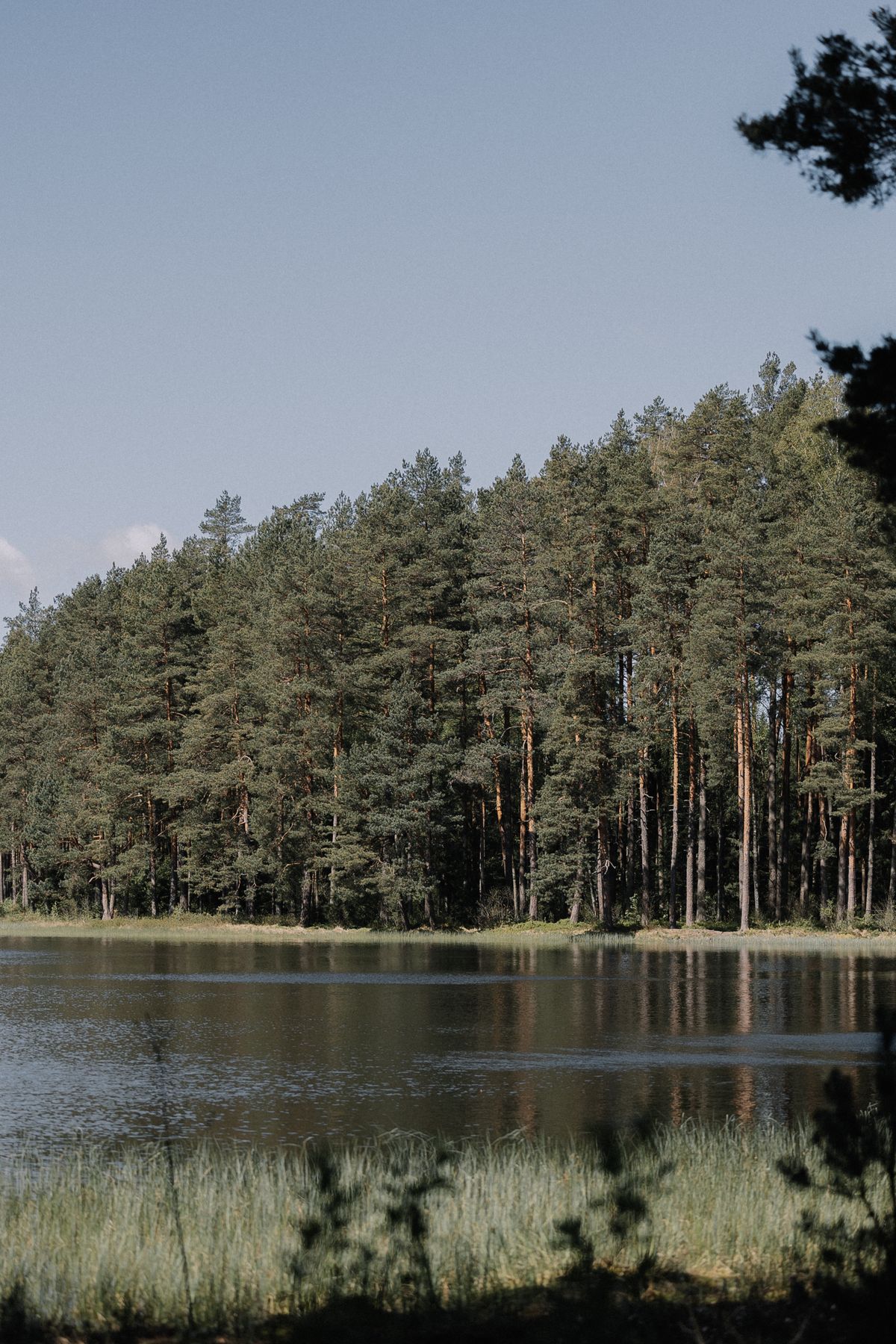
The Swedish alternative sits in a different supply-demand relationship. The country has 97,500 lakes, most of which have rentable cabins on their shores. These stugor — forest or lakeside cabins — are Sweden's natural accommodation format: typically simple (running water, a wood stove, a rowing boat, a sauna), often extraordinary in setting, and priced outside the speculative peak-season market that Mediterranean coastal accommodation operates in. A four-person cabin on a Dalarna lake in July costs between 4,000–7,000 SEK per week (roughly £300–500). A comparable week in a Santorini or Amalfi property at the same season is three to five times that amount, for a smaller space, with no lake, no rowing boat, no sauna, and no legal right to forage for mushrooms within walking distance.
The archipelago cottages deserve separate mention. The Stockholm archipelago — 27,000 islands spread across 80 kilometres of Baltic — has rental properties on islands that have no cars, no roads and ferry access once or twice a day. These are not expensive. They are not well-known to international travellers. They represent a quality of place — the specific silence of a car-free island on a calm summer evening — that is not purchasable at any price in the Mediterranean, because the Mediterranean has no such islands available to the general public.

Other Escape45 Destinations: Why Sweden Specifically
The 45th parallel runs through much of Europe above the heat zone, and several countries north of it offer genuine Escape45 value. Understanding why Sweden is the primary recommendation requires looking at the alternatives.
Norway is above the 45th, spectacularly beautiful, and much more expensive than Sweden across all categories. The fjords are extraordinary and the hiking is genuinely good. For pure Escape45 value — the ratio of natural access to financial cost — Norway is harder to argue for than Sweden. The Allemansrätten equivalent (allemannsretten) exists in Norway but is less extensive, and the wild camping infrastructure is less developed.
Finland sits at similar latitudes to Sweden with comparable natural character. Its lake system is the most extensive in Europe and its sauna culture is deeper than Sweden's. Finland is an excellent Escape45 destination, but its tourism infrastructure for non-Finnish speakers is less developed than Sweden's, its city culture (beyond Helsinki) is harder to access, and the archipelago experience — while it exists and is excellent in the Turku region — is less dramatic than the Stockholm or Gothenburg equivalents.
Scotland is above the 45th parallel and has the latitude benefit, but its climate is genuinely different: more maritime, more consistently wet, with a narrower window of good summer weather. It is an Escape45 destination but a conditional one — the Escape45 works best when the weather cooperates, and Scotland's weather cooperates less reliably than Sweden's high-pressure summer systems.
The Baltic states — Estonia, Latvia, Lithuania — are above the 45th and worth considering, particularly Estonia's island chains (Saaremaa, Hiiumaa) and the forested national parks. They lack the scale of Swedish nature and the equivalent of Allemansrätten, but they offer comparable latitude benefits at even lower cost than Sweden, and are increasingly accessible by budget airline.
Sweden's specific combination is what makes it the primary Escape45 destination: the constitutional right of access to all land (Allemansrätten), the sheer scale of unspoiled nature (63% forest cover, almost 100,000 lakes), summer temperatures warm enough to function as a holiday (23°C, lake water 20°C in July), modern city culture for those who want it, reliable infrastructure and English fluency everywhere. No other destination above the 45th has all of these simultaneously.

Planning Your Escape45: The Practical Checklist
The concept is clear. The execution requires a few specific decisions that differ from planning a Mediterranean holiday.
Timing. The Escape45 summer window in Sweden is genuinely June to August, with July being the peak. Late June and early August are excellent shoulder options — cheaper accommodation, fewer tourists, still 18+ hours of daylight. September is the beginning of autumn and a different but equally good kind of trip.
Where to base yourself. The choice is essentially city (Stockholm or Gothenburg, for culture, food, and archipelago access), cabin country (Dalarna, Värmland, Småland for the classic lake-and-forest experience), or island (Gotland, Öland, or the archipelago for the Baltic island experience). Most good Escape45 trips combine two: a couple of days in Stockholm followed by a week in a lake cabin, or a Gothenburg base with day trips along the Bohuslän coast.
Getting there. Flights from most European cities to Stockholm Arlanda or Gothenburg Landvetter are straightforward and often cheaper than equivalent flights to Mediterranean cities. The train from Hamburg to Stockholm (SJ overnight service) is an increasingly popular option that arrives central and avoids airports entirely. From the UK, a direct flight to Stockholm takes 2.5 hours.
The cabin booking. Swedish summer cabins book out early — the popular Dalarna and lake-district properties go in January and February for July. Booking in March or April is still possible but limits choice. The platforms: Stuga.se, Blocketboende, and Airbnb all have Swedish cabin inventory. For archipelago properties, the ferry company Waxholmsbolaget has links to island accommodation.
Packing. See the complete Sweden packing guide for the full seasonal list. The Escape45 summer essentials: a waterproof shell (Swedish summer can rain without warning), a light fleece for evenings (it will drop to 14°C), swimwear (you will swim, multiple times, in a lake), and insect repellent for any time spent near water after June.
Escape45: Is It Just Trend Language?
Some travel writing treats every naming convention as marketing. The question is fair: is "Escape45" a meaningful concept or is it just a memorable shorthand for "go somewhere cooler"?
The case for it being meaningful: the 45th parallel is a real geographic and climatic boundary, not an arbitrary number. The climate data that shows diverging temperature trajectories above and below it is real. The experience difference between travelling at 38°C and at 23°C is real and measurable in health outcomes, activity levels, sleep quality and subjective wellbeing reports. And the shift in travel behaviour it's describing — the movement away from Mediterranean summer and toward northern alternatives — is being documented by tourism economists, not invented by travel bloggers.
The case against: any line is somewhat arbitrary, and "above the 45th" includes places (inland France, northern Italy, Austria) that have their own summer heat problems, just slightly less severe. The concept works better as a directional principle than a precise rule. Scotland is above the 45th but is genuinely cold in a way Sweden isn't. Iceland is above it but not the same experience.
What gives Escape45 its staying power as a concept is that it matches something people were already feeling before they had a name for it. The dissatisfaction with the heat below the line, the tentative interest in the cooler alternatives above it — those existed as scattered individual experiences. The naming collects them into something recognisable. That's what useful travel concepts do.
Mistakes Travellers Make About Escape45
❌ Assuming "cooler" means cold or uncomfortable
Stockholm in July averages 23°C — warm enough to swim in lakes, sit outdoors all day, and wear a t-shirt until 9pm. The Escape45 is not an escape to cold. It's an escape from dangerous heat to comfortable warmth.
❌ Treating it as a trend rather than a structural shift
The temperatures below the 45th are not returning to their 1980s baseline. The climate projection models are consistent: Mediterranean summers will continue to intensify. Escape45 is not a response to a bad few years. It is a response to a permanently altered situation.
❌ Confusing latitude with year-round climate
The Escape45 argument applies specifically to summer (June–August). Sweden in January is a different calculation entirely — which is why this site covers both summer and winter, and treats them as separate propositions. The winter Coldcation to Lapland is its own argument, not an extension of the summer heat escape one.
❌ Thinking only Sweden qualifies
Norway, Finland, Iceland, Scotland and the Baltic states are all above the 45th. The Escape45 is a principle, not a single destination. Sweden is our specific recommendation because of its combination of access, infrastructure, natural diversity and the Allemansrätten right — but the latitude benefit is shared across northern Europe.
Frequently Asked Questions: Escape45
What is Escape45?
Escape45 is the idea of travelling above the 45th parallel north to escape the heat that has made summer travel below it increasingly unpleasant and in some years dangerous. The 45th parallel runs through southern France and northern Italy — everything south of it (Spain, Greece, Portugal, the Mediterranean) has experienced significant summer temperature increases. Everything above it, particularly Scandinavia, has not.
Which cities are above the 45th parallel in Europe?
Stockholm (59°N), Gothenburg (57°N), Malmö (55°N), Copenhagen (55°N), Oslo (59°N), Helsinki (60°N), Edinburgh (55°N), Amsterdam (52°N), Brussels (50°N), and London (51°N). All of these sit above the 45th parallel and experience meaningfully cooler summers than Rome, Athens, Madrid or Barcelona.
Is Sweden warm enough for a summer holiday?
Yes. Stockholm averages 23°C in July, with regular spells of 26–28°C. Lake water temperatures reach 20–22°C, making swimming genuinely pleasant. The archipelago is warm and calm. It is not the Mediterranean — evening temperatures drop to 14–16°C — but it is warm enough for every outdoor activity, and that temperature drop in the evening is part of what makes it restorative.
Where did the term Escape45 come from?
The term was coined on Coldcation.se to describe the specific travel behaviour of people choosing destinations above the 45th parallel to escape Mediterranean summer heat. It appeared in travel media from 2025 onwards as the trend became significant enough to report on. The 45th parallel was chosen as the reference latitude because it's a real climatic boundary, geographically meaningful, and coincides with the approximate northern edge of the Mediterranean climate zone.